Connected Energy: High-Availability Infrastructure from the Dam to the Data Center
Energy utility companies often operate their facilities across widely distributed locations, ranging from measurement and control equipment in the mountains to turbines and control centers in the valleys, as well as central services in a data center.
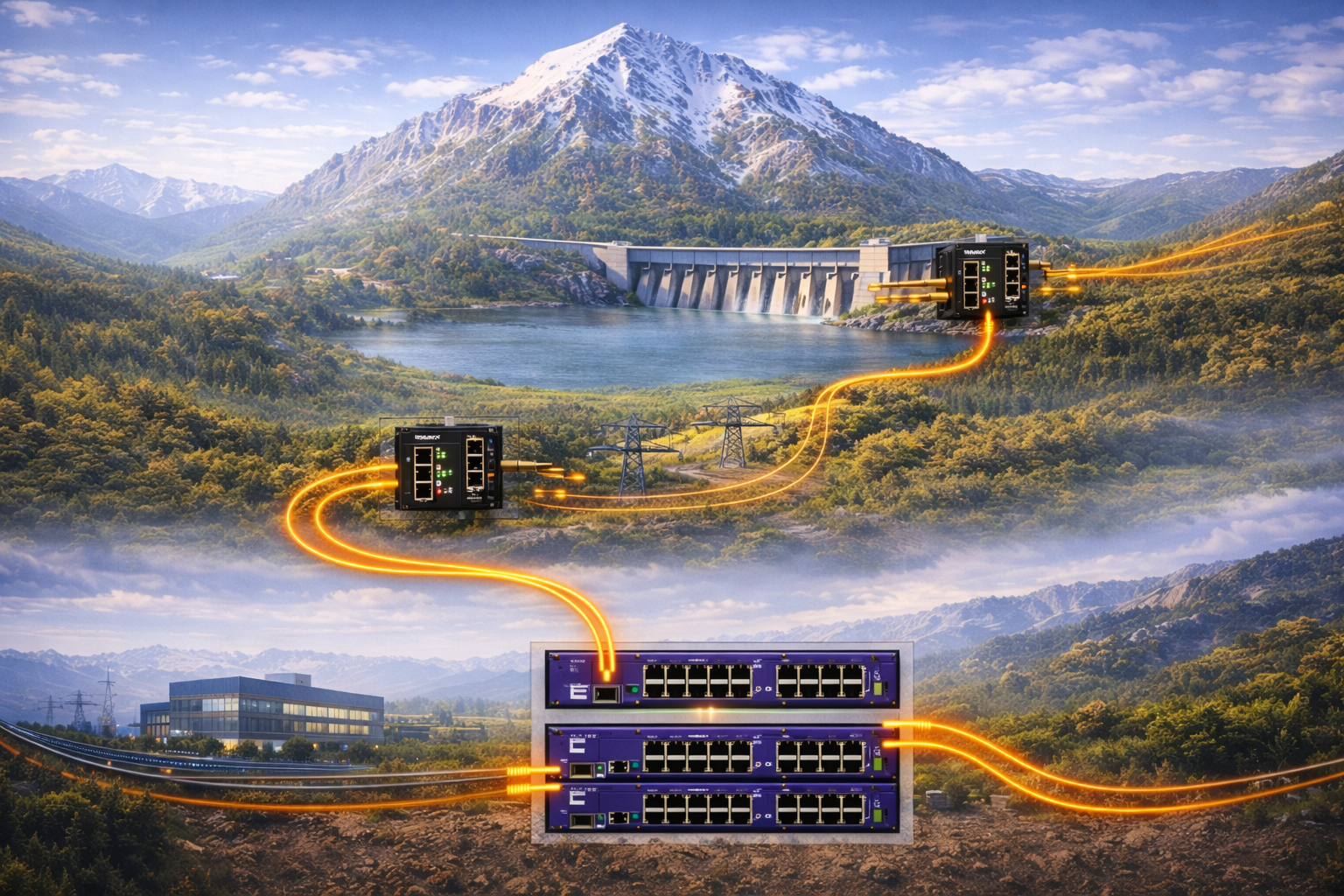
These sites must be networked reliably, securely, and often across diverse topologies—a classic star topology is rarely feasible in practice. This is exactly where the combined solution from Extreme Networks and Aginode comes in, connecting high-availability core networks with industrial-grade edge components into a seamless, automated network architecture.
In the core and backbone areas, the Extreme Networks Fabric provides a stable foundation. It connects control centers, data centers, and central services across multiple locations and, thanks to Shortest Path Bridging (SPB), ensures that all available connections are utilized actively. Various topologies, whether ring, mesh, or point-to-point, can be implemented flexibly. The network independently selects the optimal path at all times and reacts automatically to interruptions without affecting operations.
Industrial Aginode switches are deployed in transformer stations, substations, and power plants, such as at dams in hydroelectric plants or in remote distribution facilities. These switches are designed for operation in harsh, unattended environments and reliably connect sensors, controllers, and field-level OT components to the central infrastructure. Through Fabric Attach, they are seamlessly integrated into the Extreme Fabric, ensuring that new OT components are recognized, automatically receive the appropriate network services, and become part of the overall structure with minimal configuration effort.
If required, the solution can be easily expanded at any time to include central access control with ExtremeControl (NAC). This allows devices to be uniquely identified and authorized based on roles without needing to adjust the existing network structure. As a result, the environment remains flexibly scalable and can be step-by-step adapted to increasing security requirements. The outcome is a highly available, secure, and easy-to-operate network platform that meets the demands of critical infrastructures—from remote measurement points to the data center. This type of networking is becoming increasingly important in the energy sector to guarantee stable, secure, and efficient operations in the long term.